
If Checks Are Declining, Why Is Check Fraud a Hot Topic?

By Jim Olney, Vice President, Payments Strategy
September 9, 2025
Would you think it strange if you were waiting in line at your local big box store and the person ahead of you was buying bleach, acetone, rubbing alcohol and plastic gloves? Would you think twice about putting mail that contained a check in your outgoing mailbox with the flag up? Did you know that the best pen to use to write out checks is a black gel pen? If you’re unaware of the prevalence of check fraud, the above scenarios likely aren’t on your radar — but they should be.
Altering checks and creating counterfeits is easy to do and is highly effective. Fraudsters are getting away with it because counterfeit and altered checks are difficult for financial institutions to identify – until it is too late and someone takes a loss. This makes checks a low hanging fruit that is ripe for fraud. U.S. financial institutions, businesses and consumers absorbed an estimated $20 billion in check fraud losses in 2023. That number is on the rise – seemingly in an inverse relationship to check volume.
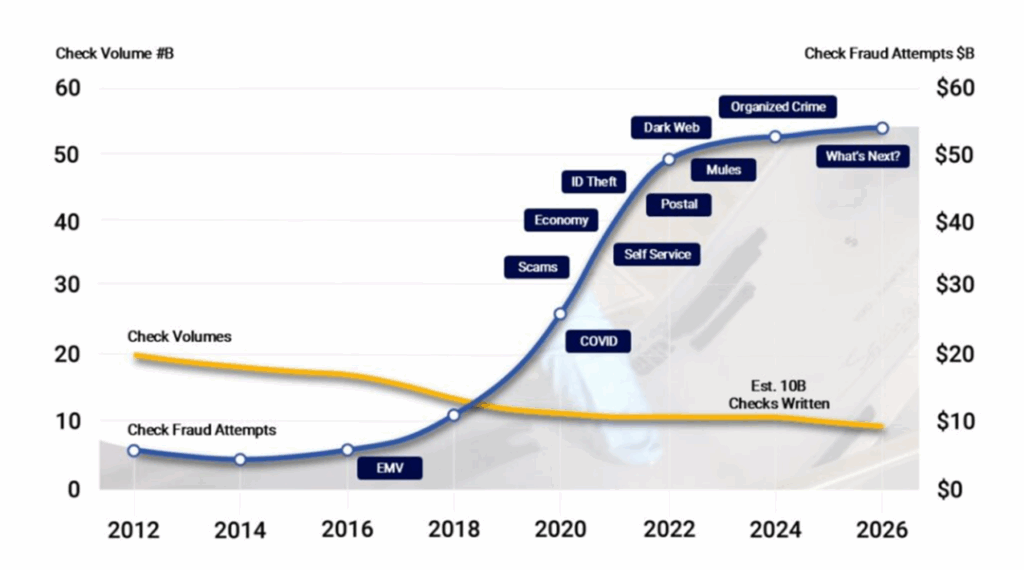
Source: OrboGraph
The check fraud business has become so lucrative that the dark web is now a hub for check fraud activity, where criminals can purchase stolen check stock and personal information, and even watch tutorials on check washing techniques.
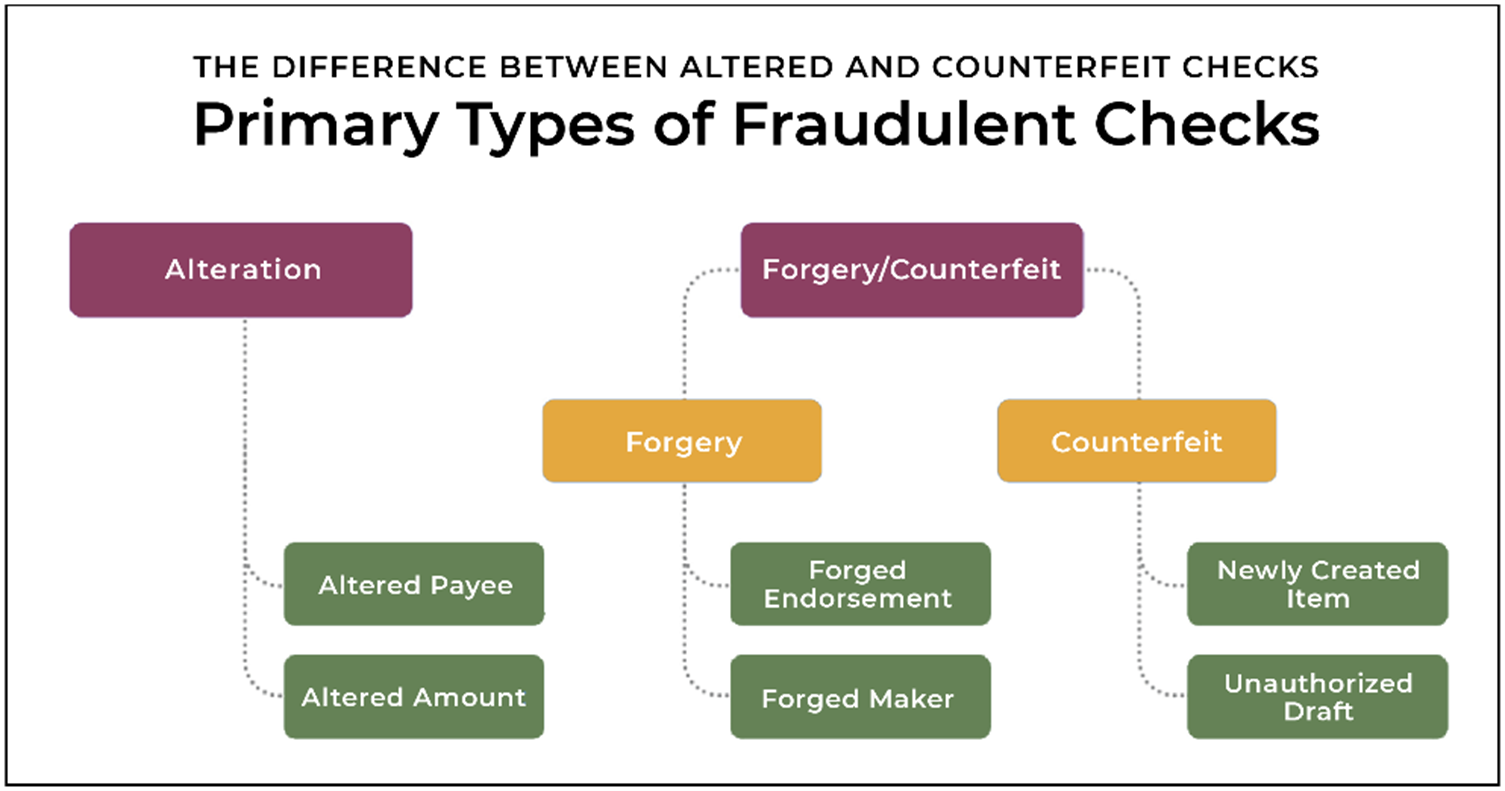
It is easy for criminals to produce convincing counterfeit checks using readily available software and printing technology. Criminals can use household chemicals to remove ink from a check to alter the payee or change the amount on a legitimate check. Check security features, logos, hand-writing styles and signatures can all be replicated in a way that is indistinguishable to humans.
The difference between altered checks and counterfeit checks is an important distinction for financial institutions. Regulations stipulate which financial institution warranties the authenticity of a check, ultimately defining who is liable if the fraudulent item isn’t returned on a timely basis. If the money is no longer in the account, some party is taking the loss. Regulations and account disclosures define who this is.
The growth of check fraud is a complex issue fueled by technological advancements, vulnerabilities in payment systems and the availability of resources for fraudsters. Check fraud doesn’t have to be a losing battle though. There are several ways for financial institutions, businesses and consumers to protect themselves against this evolving threat:
Stay Educated and Aware
As the saying goes, “An ounce of prevention is worth a pound of cure.” In the same way, financial institutions can stop fraud before it starts by proactively pursuing education and awareness of fraudsters’ latest tactics. The Federal Reserve recently published a comprehensive check fraud toolkit on their website that can help financial institutions do just that. This toolkit offers a wide range of informative resources useful to financial institutions, businesses and consumers who want to defend themselves against check fraud.
Verify Authenticity on Treasury Checks
Existing fraud solutions are improving, and new ones are emerging. One such noteworthy tool for financial institutions is the improved Treasury Check Validation System.
Checks issued by the U.S. Treasury are particularly attractive to fraudsters due to the next-day availability rule and general acceptance of government issued checks. Financial institutions now have access to an Application Programming Interface (API) version of the Treasury Check Validation System (TCVS), which supports payee name validation. This enhanced version of TCVS allows financial institutions to confirm if the check is valid and matches the Treasury's records. Your check processor should have access to this valuable service. Alloya incorporated the service within TranzCapture in August 2025.
Monitor transactions for anomalies
Financial institutions and businesses should develop procedures to monitor account activity daily and search for anomalies. Businesses should be encouraged to reconcile their check registers, not simply by matching check number and amount, but also ensuring the payee is correct. Technology tools can help review high volumes of transactions and identify anomalies. At a minimum, financial institutions and businesses should find an acceptable threshold based on their risk tolerance, e.g. $2,000, and review every check above that amount to validate authenticity.
The Uniform Commercial Code states that checks must be returned by midnight on the day following presentment, and Regulation CC § 229.31 (b)(2) further states that the return must be made available to the bank of first deposit by 2:00 pm local time the following day for guaranteed credit. Consumers should be encouraged to review check clearings on their account frequently. Check fraud can occur even if they don’t write checks.
Evaluate third-party fraud tools
Numerous third-party tools are available to assist with check fraud mitigation. These tools will not necessarily confirm a check is fraudulent, but they will call attention to suspect items for further review and validation.
Financial institutions, businesses and consumers should evaluate their susceptibility to check fraud, assess historical losses incurred and gauge potential losses in the future. It may be worthwhile to shore up monitoring procedures or spend money on tools to catch check fraud in its tracks. It is time to pour cold water on this hot topic.