
Why Real-Time Payments
Also known as instant or immediate payments, real-time payments move and settle funds instantaneously and irrevocably, 24 hours a day, seven days a week, 365 days a year. There are two major networks that can facilitate a tried-and-true real-time payment: The Clearing House’s RTP® network and the Federal Reserve’s FedNow® Service. Financial institutions are not required or mandated to use or offer real-time payments, but predictions show that consumers and businesses will soon expect the capabilities from their primary financial institution not only because of their speed and convenience, but also for their potential to improve quality of life.
Remember when online banking was considered a nice-to-have convenience? A capability that improved quality of life but wasn’t considered absolutely necessary? Many would agree this is now non-negotiable. In the not-too-distant future, real-time payments are expected to become non-negotiable, too. However, in the words of Tyler Lange, Director of Payments at Consumers Credit Union in Lake Forest, IL, “This is something your members are not going to ask for.”
As a behind-the-scenes service without a consumer-facing brand, members are not likely to inquire with their financial institution about real-time payments. They’ll simply know what experience they’re looking for, identify when that need is not being met and shop around until they find it.
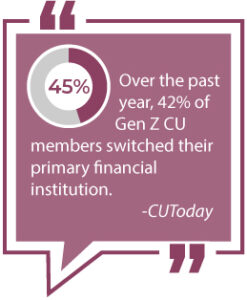 Citing a recent report from PYMNTS and Velera, CUToday called Gen Z a “fickle” generation. “Over the past year, 42% of Gen Z CU members switched their primary financial institution” CUToday shared. Compared to their Gen X counterparts, Gen Zers are more than twice as likely to switch. This tracks with research conducted by The Financial Brand that indicates 44% of consumers will leave their financial institution for digital banking that is similar to the online shopping experience. While 56% of consumers say they would prefer to bank with a community financial institution, they say their digital offerings do not meet their needs. So, it’s unsurprising that 57% of consumers would consider banking with Apple, Amazon or another non-traditional financial institution to get their needs met. In fact, a Co-Op CU Growth Outlook (2023) found that credit union members have triple the number of financial relationships as most non-credit union members on average.
So, if your credit union has historically hung its hat on member loyalty, there will likely come a point where loyalty is no longer enough to retain members and sustain your credit union. Members know what they want, and they’ll do what it takes to gain access to it. Just because your members aren’t asking for real-time or instant payments by name does not mean they are disinterested. Not asking is not the same as not wanting. In fact, if your members have to ask, it's likely already too late.